
Bridal Basics
- Bethany Murphy
- Sep 10, 2022
- 2 min read
Updated: Mar 12, 2023
On my first day on the job I was practicing all the basics of altering a wedding gown, the main basics included bustles, bust cups, and straps. I quickly learned how essential and popular these adjustments are regarding fittings. The majority of brides will have these three basic alterations so it is important that they are done both to a high standard and quickly so that valuable time is saved for more time-consuming tasks such as take-ins.
Straps are the most common custom accessory a customer will add to their dress, and they are simple to attach as it is just a simple hand stitch to secure them in. The front strap is usually placed on the inside or just left of the bust cup, with the back of the strap sitting between the zip and the last piece of boning.

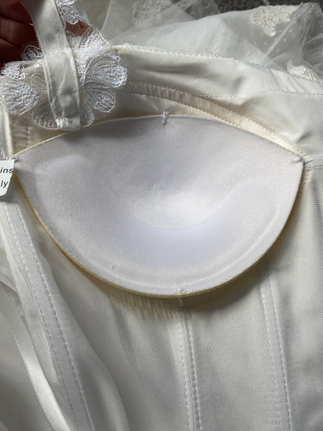


Bust cups are extremely popular amongst brides and are often up-sold by seamstresses at fittings as they help the customer's bust sit into the structure of the dress properly, giving more cleavage which is favored by many especially if a dress is a low cut. Having bust cups could also remove the need for a take-in that is cheaper for the customer and less work for the seamstress.
When it comes to the fitting the customer will be given the bust cups to place under their bust and the option of having either 1 or 2. If 2 bust cups are needed they are simply sewn on top of one another to create more padding. They are then sewn into the bust of the dress, making sure it follows the boning structure inside the gown, using a double thread they are sewn on either side and at the top. The cup will then be lifted leaving a small gap at the bottom so it is secured to the dress with a chain stitch.




The final popular adjustment made to wedding dresses is a bustle, which I always recommend to every bride as it elegantly hooks the train up so it is more convenient on the day but still looks beautiful. It is a simple mechanism, including a strong metal button that will either be sewn onto the bottom of the zip/corset many times with a double thread wrapped around to help it hold for longer. The dress is then folded up to the button to make sure the loop is sewn in the correct place, usually between the button and the end of the train. Then the loop is created by a simple chain stitch making sure it is big enough to fit your finger through in order for it to fit over the button easily.


I'm sure throughout my year placement at Elite Bridal I will be carrying these alterations multiple times and I look forward to learning how to do more complex adjustments.


Comments